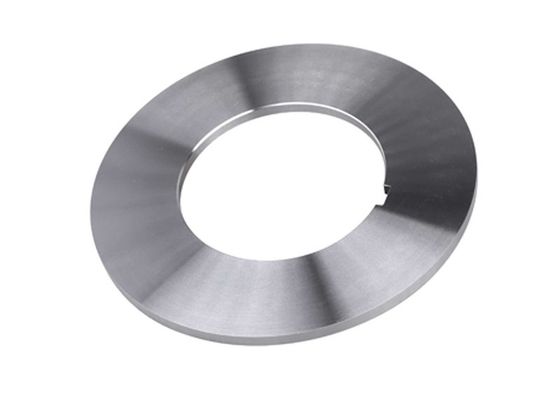
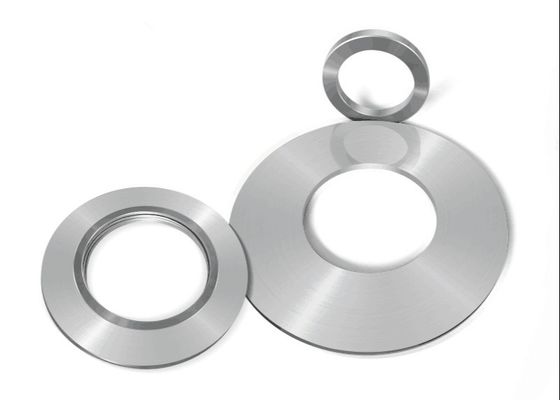
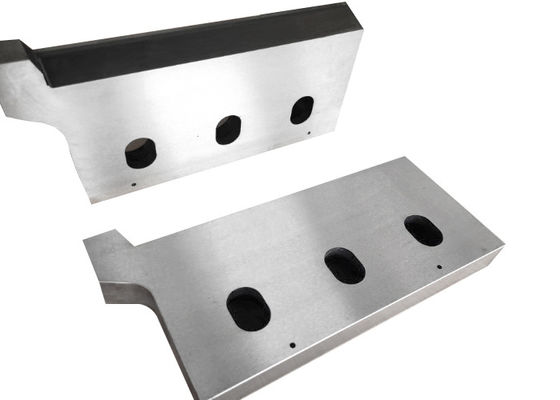
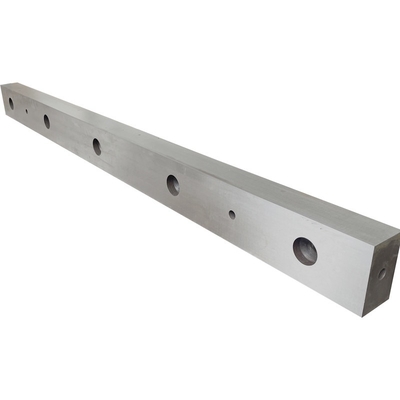
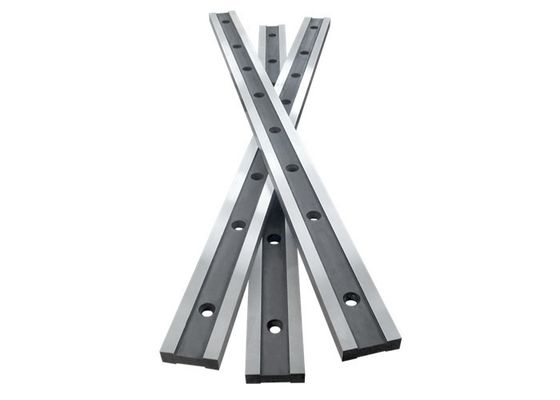
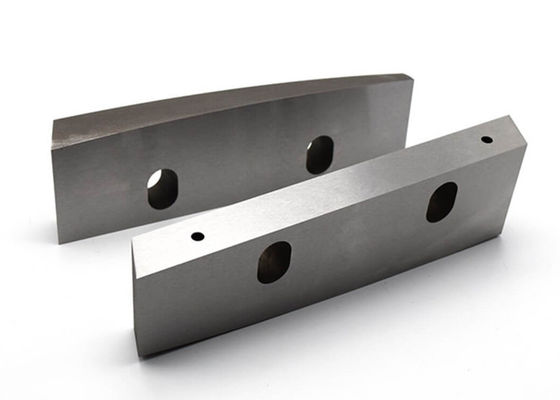
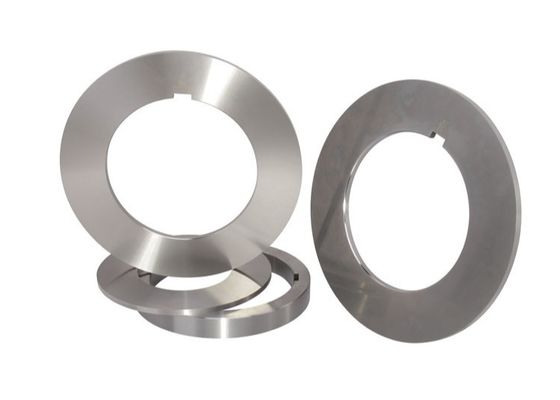
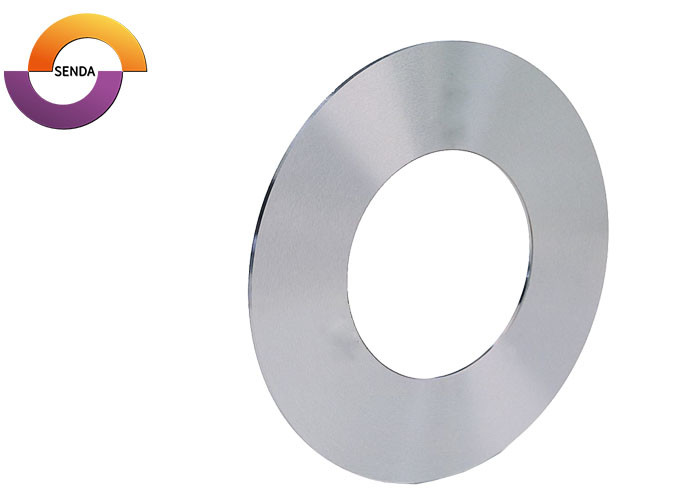
SENDA manufactures HRC55 rotary slitter blades for continuous longitudinal slitting of stainless steel sheets, coils and strips.
Each blade is customized according to the stainless steel grade, material thickness, tensile strength, slitting speed, arbor dimensions and machine conditions. D2 and SKD11 are available as the main blade material options, with a hardness range of HRC 55–57.
For applicable blade sizes, thickness tolerance can be controlled down to ±0.001 mm, parallelism down to 0.002 mm and polished surface roughness up to Ra 0.1 μm.
Key Product Information
|
Item
|
Specification
|
| Blade Material |
D2 / SKD11 |
| Hardness |
HRC 55–57 |
| Dimensions |
Customized according to drawings |
| MOQ |
2 pieces |
| Lead Time |
Around 35 days |
| Packaging |
Wooden case |
| Regrinding |
Available for overseas customers |
Product Overview
HRC55 rotary slitter blades are installed on the upper and lower arbors of stainless steel slitting machines. The blades use controlled horizontal clearance and vertical overlap to continuously divide stainless steel sheets or coils into narrower strips.
Typical applications include:
- Stainless steel coil slitting lines
- Stainless steel sheet slitting machines
- Stainless steel strip production
- Metal processing service centers
- Precision stainless steel strip processing
- Stainless steel edge trimming
- Multi-knife slitting systems
The final slitting result is not determined by hardness alone. Blade material, dimensional accuracy, cutting edge geometry, arbor condition, spacer configuration and installation parameters must also be matched to the application.
Before production, SENDA reviews the stainless steel grade, thickness, tensile strength, blade dimensions and machine conditions.
Common Problems in Stainless Steel Slitting
Excessive Edge Burrs
Excessive burrs may be related to incorrect horizontal clearance, worn cutting edges, blade installation errors or arbor runout.
Blade thickness and parallelism also affect the cutting position between the upper and lower blades. In multi-knife slitting systems, dimensional deviations in individual blades and spacers may accumulate and change the actual cutting clearance.
Burr control therefore requires an evaluation of both the blades and the complete tooling configuration.
Cutting Edge Chipping
Blade chipping is not always caused by insufficient hardness.
If hardness is too high without sufficient toughness, local chipping may occur when slitting high-strength stainless steel, operating with excessive blade overlap or encountering abnormal impact.
If hardness is too low, cutting edge wear and regrinding frequency may increase.
The HRC 55–57 range must therefore be matched with the heat-treated condition of D2 or SKD11, stainless steel strength, material thickness and machine load.
Uneven Blade Wear
One-sided or localized blade wear may be related to:
- Blade flatness or parallelism
- Arbor runout
- Spacer thickness configuration
- Tooling locking condition
- Uneven loading
- Variations in stainless steel thickness
- Incorrect matching between blade and workpiece
Before replacing the blades, the arbors, spacers, stripping rings and installation conditions should also be inspected.
Unstable Strip Width
Strip-width variation may be caused by blade thickness, spacer accuracy, arbor positioning, tooling locking or material tracking.
For multi-blade slitting lines, dimensional control must cover the complete tooling assembly rather than only the individual rotary slitter blades.
Why Blade Material, Hardness and Precision Must Be Matched
HRC55 Is Not the Only Selection Factor
HRC55 indicates the Rockwell hardness level of the blade, but it cannot independently determine whether the blade is suitable for a particular stainless steel slitting line.
Blade selection should also consider:
- Stainless steel grade
- Material thickness
- Tensile strength or hardness
- Slitting speed
- Required strip width
- Blade outer diameter, inner diameter and thickness
- Machine and arbor conditions
- Existing burr, chipping or wear problems
D2 and SKD11 can be heat-treated within the HRC 55–57 range. The final material and heat-treatment configuration should be selected according to the actual operating conditions.
Thickness Tolerance Affects Tooling Assembly
For applicable blade sizes, SENDA can control blade thickness tolerance down to ±0.001 mm.
In a multi-blade tooling assembly, blade and spacer thicknesses determine the accumulated tooling width. Excessive accumulated deviation may result in strip-width variation or a difference between the actual and designed cutting clearance.
The ±0.001 mm value does not apply to every diameter and thickness. Final tolerances are confirmed according to the blade dimensions and required precision grade.
Parallelism Affects Blade Contact
For applicable blade sizes, parallelism can be controlled down to 0.002 mm.
Parallelism deviation may cause localized contact, uneven loading or inconsistent cutting edge wear. Controlled parallelism helps maintain the intended contact position between the upper and lower blades.
Surface Roughness Affects Friction and Contact
The standard fine-ground surface can reach Ra 0.2 μm.
For applicable blade sizes, a polished surface of up to Ra 0.1 μm is available.
The required surface finish should be selected according to stainless steel surface requirements, material adhesion, slitting speed and operating conditions.
SENDA HRC55 Rotary Slitter Blade Solution
Customized According to Drawings and Operating Conditions
SENDA manufactures HRC55 rotary slitter blades according to customer drawings, physical samples or existing blade dimensions.
Customizable items include:
- Outer diameter
- Inner diameter
- Blade thickness
- Bore fit
- Cutting edge geometry
- Hardness
- Flatness
- Parallelism
- Surface roughness
- Rust protection
- Packaging method
The stainless steel grade, thickness range, tensile strength, slitting speed and machine conditions are reviewed before production.
D2 and SKD11 Material Options
D2 and SKD11 are cold-work tool steels used for metal slitting blades.
The final material selection depends on:
- Stainless steel strength
- Material thickness
- Cutting edge load
- Expected wear mode
- Chipping risk
- Regrinding requirements
- Slitting line conditions
The HRC 55–57 value shown on this page is the available blade hardness range. It does not mean that every application uses an identical heat-treatment process.
Precision Grinding and Dimensional Control
SENDA controls the following items according to the blade dimensions and approved drawing:
- Blade thickness
- Flatness
- Parallelism
- Bore dimensions
- Concentricity or radial runout
- Cutting edge condition
- Surface roughness
For applicable blade sizes:
- Thickness tolerance can reach ±0.001 mm
- Parallelism can reach 0.002 mm
- Standard surface roughness can reach Ra 0.2 μm
- Polished surface roughness can reach Ra 0.1 μm
Complete Slitting Tooling Support
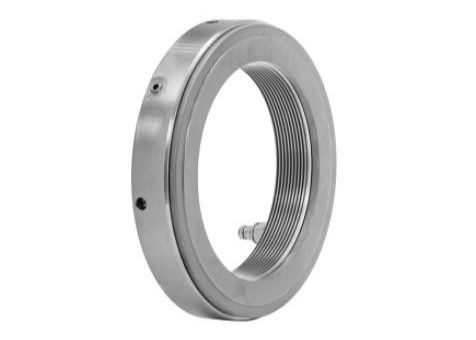
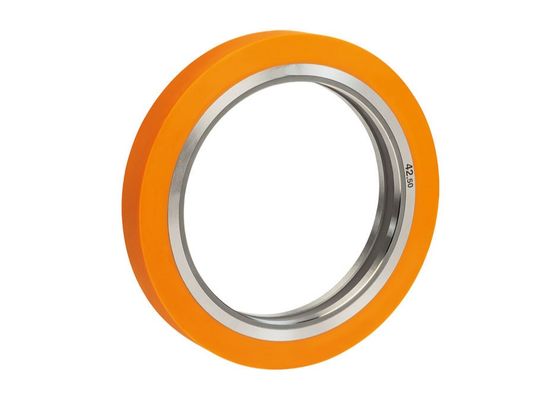
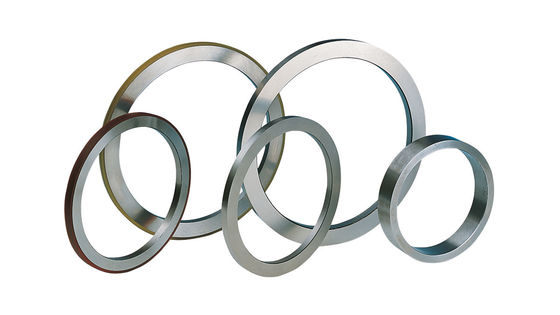
In addition to rotary slitter blades, SENDA can provide matching tooling components according to the required strip width, material stripping method and machine structure.
Available components include:
- Steel spacers
- Shims
- PU rings
- Rubber rings
- Separator rings
- Steel stripper rings
Blades, spacers and stripping components should be configured as a complete tooling system to reduce dimensional mismatch and unstable material stripping.
Technical Specifications
|
Parameter
|
Specification
|
| Product Name |
HRC55 Rotary Slitter Blades |
| Application |
Stainless steel sheet, coil and strip slitting |
| Blade Material |
D2 / SKD11 |
| Hardness |
HRC 55–57 |
| Outer Diameter |
Customized according to drawing |
| Inner Diameter |
Customized according to arbor dimensions |
| Blade Thickness |
Customized according to tooling configuration |
| Thickness Tolerance |
Down to ±0.001 mm for applicable blade sizes |
| Parallelism |
Down to 0.002 mm, depending on dimensions |
| Flatness |
Controlled according to blade diameter, thickness and drawing requirements |
| Bore Tolerance |
According to the approved drawing and arbor fit |
| Concentricity / Radial Runout |
According to the approved drawing and inspection datum |
| Standard Surface Roughness |
Ra 0.2 μm |
| Polished Surface Roughness |
Up to Ra 0.1 μm for applicable blade sizes |
| Edge Geometry |
Customized according to the slitting application |
| Manufacturing Basis |
Drawing, sample or existing blade dimensions |
| Matching Tooling |
Spacers, shims, PU rings, rubber rings and stripper rings |
| MOQ |
2 pieces |
| Lead Time |
Around 35 days |
| Standard Packaging |
Wooden case |
| Regrinding Service |
Available for overseas customers |
| Certification |
ISO 9001 |
| Country of Origin |
China |
Note: The listed precision values do not apply to every blade size. Final tolerances and inspection criteria are confirmed according to the blade diameter, thickness, material and approved drawing.
Stainless Steel Slitting Applications
HRC55 rotary slitter blades are used for longitudinal slitting of stainless steel sheets, coils and strips.
The blade configuration should be selected according to the specific stainless steel grade and operating conditions.
Different stainless steel grades may have different:
- Tensile strength
- Work-hardening behavior
- Surface requirements
- Edge-cutting requirements
- Chipping and wear risks
The general description “stainless steel” is not sufficient for final blade selection. Customers should provide the material grade, thickness range and strength information.
How HRC55 Rotary Slitter Blades Work
Rotary slitter blades are normally installed in pairs on upper and lower arbors.
As the stainless steel passes through the machine, the upper and lower blades create a continuous shearing action through controlled horizontal clearance and vertical overlap.
The final cutting condition is affected by:
- Blade material and hardness
- Cutting edge condition
- Horizontal clearance
- Vertical overlap
- Arbor accuracy
- Blade parallelism
- Spacer thickness configuration
- Stripper-ring arrangement
- Material thickness
- Tensile strength
- Production line speed
A single fixed clearance ratio should not be applied to every stainless steel grade.
Horizontal clearance should be selected according to the stainless steel grade, material thickness, tensile strength, required edge condition and machine condition.
Insufficient clearance may increase cutting load, wear and chipping risk. Excessive clearance may result in a wider fracture zone, increased burrs or edge deformation.
How to Select the Correct HRC55 Slitter Blade
Confirm the Stainless Steel Material
Please provide:
- Stainless steel grade
- SUS series
- Material condition
- Tensile strength
- Yield strength or hardness
The material grade and strength affect blade material, hardness, edge geometry and cutting clearance.
Confirm the Material Thickness
Please provide:
- Normal operating thickness
- Minimum thickness
- Maximum thickness
- Whether the thickness changes during production
Material thickness affects blade load, dimensions, clearance and overlap requirements.
Confirm the Blade Dimensions
Recommended information includes:
- Outer diameter
- Inner diameter
- Blade thickness
- Keyway or mounting structure
- Cutting edge geometry
- Existing blade material
- Existing blade hardness
A technical drawing is preferred. When no drawing is available, customers can provide photographs, dimensions or physical samples of the existing blades.
Confirm the Machine and Production Parameters
Please provide:
- Slitting machine model
- Arbor dimensions
- Slitting speed
- Required strip width
- Number of blades in each tooling set
- Tooling locking method
- Existing spacer and stripping-ring configuration
The blades must be matched with the arbors and complete tooling system. They should not be manufactured using only outer diameter and inner diameter information.
Describe Existing Slitting Problems
Please explain any current problems, including:
- Excessive burrs
- Cutting edge chipping
- Frequent regrinding
- Uneven upper and lower blade wear
- Unstable strip width
- Stainless steel surface scratches
- Material adhesion
- Unstable material stripping
SENDA can review whether the blades, clearance, spacers, arbors and installation conditions should be adjusted together.
Manufacturing Process
The manufacturing route for HRC55 rotary slitter blades is determined according to blade material, dimensions, structure and precision requirements.
A typical process includes:
- Drawing and application review
- Blade material selection
- Raw material inspection
- Blank preparation or forging
- Heat treatment and tempering
- CNC rough machining
- Internal and external machining
- Precision surface grinding
- Cutting edge machining
- Fine grinding or polishing
- Demagnetization and rust prevention
- Final inspection
- Wooden case packaging
Thin blades, large-diameter blades and special edge geometries may require different controls during heat treatment and grinding.
Inspection and Quality Control
SENDA was founded in 1998 and has more than 100 employees. Production and inspection are managed under an ISO 9001 quality management system.
Depending on the order and approved drawing, inspection items may include:
- Blade material
- Hardness
- Outer diameter
- Inner diameter
- Blade thickness
- Flatness
- Parallelism
- Concentricity or radial runout
- Surface roughness
- Cutting edge condition
- Surface scratches
- Chipping and burrs
- Product marking
- Rust protection
- Packaging condition
Final inspection requirements are based on the approved drawing, order and technical agreement.
Overseas Regrinding Service
SENDA provides return-to-factory regrinding services for overseas customers.
Before regrinding, the used blades are evaluated for:
- Cutting edge wear
- Chipping depth
- Remaining blade dimensions
- Material and hardness condition
- Previous regrinding history
- Flatness and parallelism
- Cracks or abnormal damage
When the blades remain suitable for regrinding, SENDA can carry out edge restoration, precision grinding, dimensional reinspection, rust prevention and repackaging.
Not every used blade can be reground. Blades with deep chipping, insufficient remaining dimensions or structural damage may need to be replaced.
Packaging, MOQ and Delivery
Minimum Order Quantity
The minimum order quantity is:
2 pieces
This supports custom specifications, sample confirmation and small-batch replacement requirements.
Lead Time
The standard lead time is:
Around 35 days
The final delivery time depends on blade material, dimensions, quantity, heat-treatment route and precision requirements.
Standard Packaging
The standard packaging is a wooden case.
Packaging preparation normally includes:
- Blade cleaning
- Rust protection
- Cutting edge protection
- Individual or layered fixing
- Internal wooden case reinforcement
- External marking inspection
The packaging method is adjusted according to blade dimensions, weight and order quantity.
FAQ
Is HRC55 suitable for every stainless steel slitting application?
No.
HRC55 is one blade hardness requirement. It must also be evaluated together with the blade material, stainless steel grade, material thickness, tensile strength, slitting speed and chipping risk.
How should I choose between D2 and SKD11?
Both D2 and SKD11 can be used for metal slitting blades.
The final selection depends on stainless steel strength, thickness, cutting load, expected wear mode, chipping risk and regrinding requirements.
SENDA confirms the material and heat-treatment configuration after reviewing the operating conditions.
Can SENDA manufacture blades according to drawings?
Yes.
SENDA can manufacture rotary slitter blades according to customer drawings, existing blade dimensions or physical samples.
Drawings should preferably include the outer diameter, inner diameter, thickness, tolerances, edge geometry and material requirements.
What precision can SENDA provide?
For applicable blade sizes:
- Thickness tolerance can reach ±0.001 mm
- Parallelism can reach 0.002 mm
- Standard surface roughness can reach Ra 0.2 μm
- Polished surface roughness can reach Ra 0.1 μm
Final precision is confirmed according to blade dimensions and drawing requirements.
Can SENDA supply spacers and stripping rings?
Yes.
SENDA can provide steel spacers, shims, PU rings, rubber rings, separator rings and steel stripper rings for complete slitting-tooling configurations.
Does SENDA provide regrinding for overseas customers?
Yes.
Before regrinding, the blades must be evaluated for wear, chipping, remaining dimensions, material condition and previous regrinding history.
What information is required for a quotation?
Please provide:
- Stainless steel grade
- Material thickness range
- Tensile strength or hardness
- Slitting speed
- Required strip width
- Blade outer diameter, inner diameter and thickness
- Slitting machine model
- Drawing or sample
- Existing blade material
- Current slitting problems
- Required quantity
- Matching tooling requirements
Inquiry Information
For an application review and quotation, please provide:
- Stainless steel grade
- Minimum and maximum material thickness
- Tensile strength or hardness
- Slitting speed
- Required strip width
- Blade OD × ID × thickness
- Slitting machine model and arbor dimensions
- Existing blade material and hardness
- Current burr, chipping or wear problems
- Required spacers, shims, PU rings or stripper rings
- Drawing, photographs or sample information
- Required quantity


 Your message must be between 20-3,000 characters!