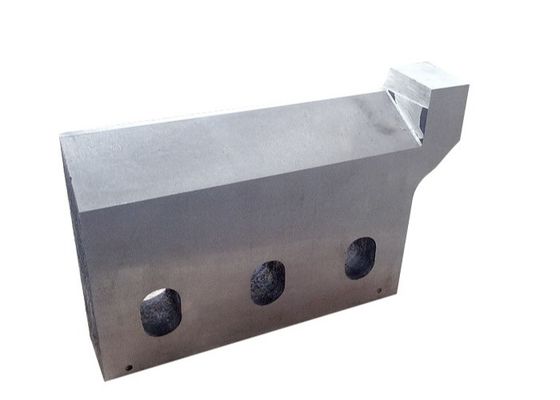
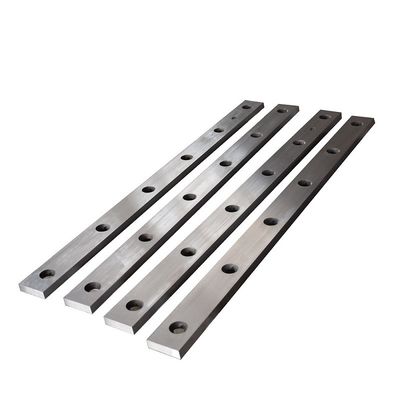
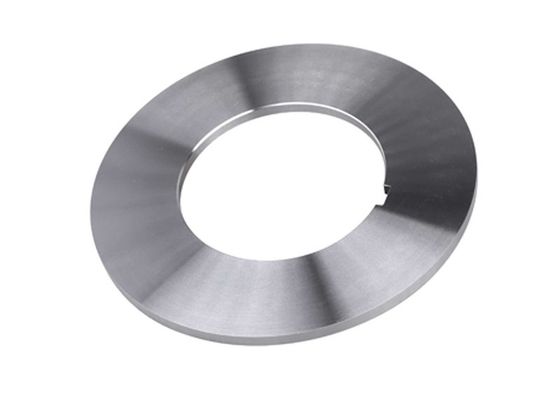
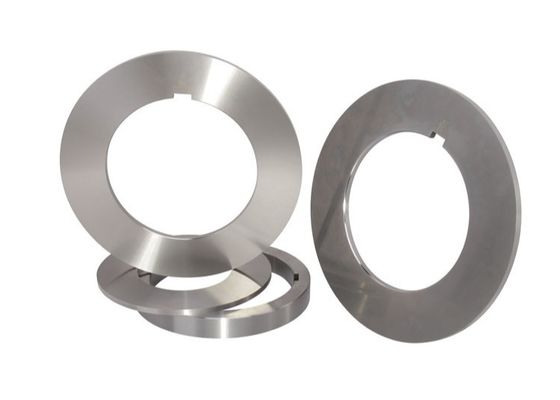
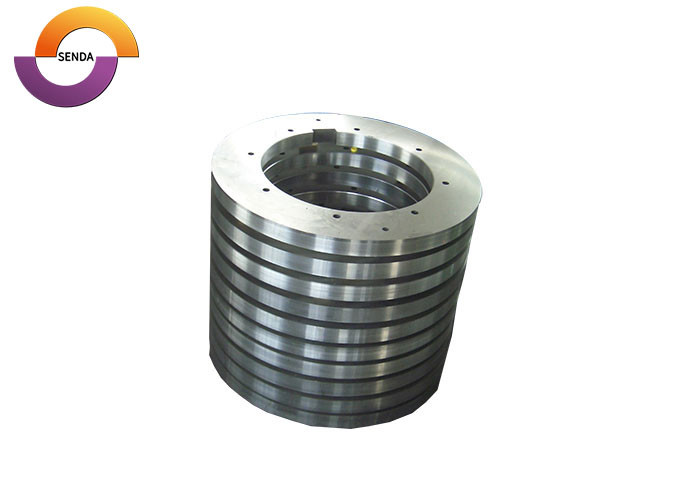
SENDA rotary slitter blades are designed for continuous longitudinal slitting of hot-rolled and cold-rolled carbon steel coils, sheets, and strips.
The upper and lower blades are installed on the slitting-line arbors. By controlling side clearance and blade overlap, a wide carbon steel coil is continuously sheared into narrower strips of the required width.
Blade material, hardness, and dimensional precision should not be determined by blade size alone. Carbon steel type, strip thickness, tensile strength, line speed, machine condition, and current cutting problems must also be reviewed.
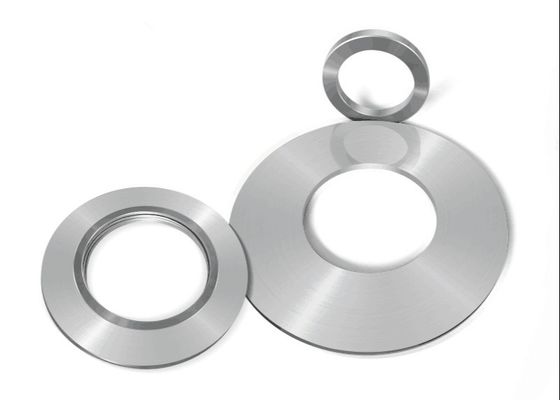
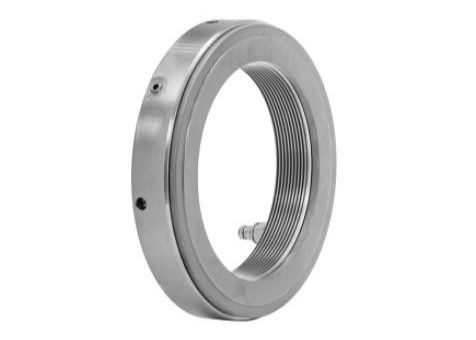
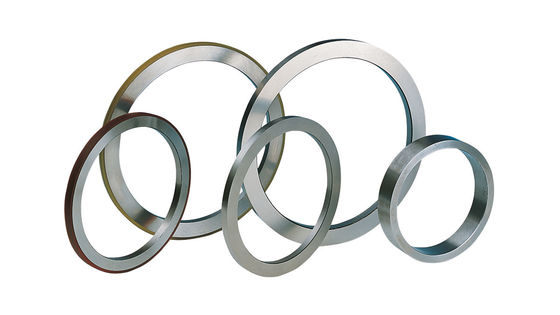
SENDA can manufacture carbon steel slitter blades according to customer drawings, existing blades, samples, machine parameters, and actual working conditions. Steel spacers, shims, rubber rings, and steel stripper rings can also be supplied as part of a matched slitting tooling system.
Product Overview
A rotary slitter blade is the main cutting component in a carbon steel coil slitting system, but it does not work independently.
In an operating slitting line, the blades normally work together with:
- Upper and lower knife arbors
- Steel spacers
- Adjustment shims
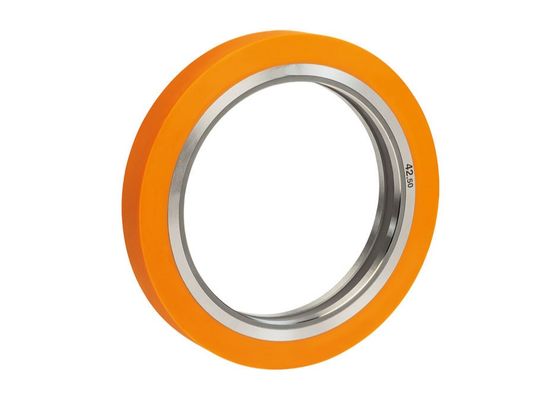
- NBR or PU rings
- Steel stripper rings
- Strip separation and guiding components
Blade material, thickness tolerance, flatness, parallelism, arbor fit, spacer accuracy, and accumulated tooling-stack error can all affect burr formation, strip width, edge condition, and operating stability.
SENDA technical information describes rotary slitter blades as the core cutting components installed on upper and lower arbors. The blades work with spacers, rubber rings, shims, and steel stripper rings to form a complete slitting tooling system.
Carbon Steel Slitting Applications

These rotary slitter blades are mainly used for:
- Hot-rolled carbon steel coil slitting
- Cold-rolled carbon steel coil slitting
- Carbon steel sheet and strip slitting
- Steel coil processing centers
- Steel service centers
- Narrow carbon steel strip production
- Continuous multi-knife slitting lines
- Carbon steel edge-trimming applications
Hot-rolled and cold-rolled carbon steel differ in surface condition, thickness, strength, and cutting load. Therefore, one fixed material or hardness specification should not be applied to every application.
Common Problems in Carbon Steel Coil Slitting
Excessive Burrs
Continuous or localized burrs are not always caused by a dull cutting edge.
Possible causes include:
- Excessive side clearance
- Insufficient blade flatness or parallelism
- Worn cutting edges
- Excessive accumulated spacer error
- Arbor runout
- Blade material or hardness not matched to the carbon steel strength
Edge Compression or Deformation
When side clearance is too small, the upper and lower blades may compress the material excessively.
This can result in:
- Rolled or compressed strip edges
- Edge deformation
- Increased cutting-edge load
- Abnormal blade contact
Blade Chipping
Blade chipping may require inspection of:
- Blade toughness
- Excessive hardness
- Heat-treatment suitability
- Changes in carbon steel strength
- Abnormal impact load
- Interference between upper and lower blades
Knife Bite or Blade Interference
Knife bite may be associated with:
- Insufficient clearance
- Poor blade flatness
- Unstable bore-to-arbor fit
- Insufficient concentricity
- Arbor precision problems
- Incorrect spacer or shim arrangement
Frequent Regrinding or Fast Wear
The following factors should be reviewed:
- Blade material wear resistance
- Heat-treatment stability
- Scale on hot-rolled carbon steel
- Slitting speed
- Cutting-edge load
- Current regrinding method
SENDA internal technical materials associate burrs, knife bite, chipping, and frequent regrinding with clearance, blade precision, material selection, toughness, and heat treatment rather than blade sharpness alone.
Diagnosing Burr Patterns in a Slitting Line
|
Slitting Result
|
Recommended Inspection Direction
|
| Irregular burrs appear across all strips |
Check the precision of the slitting machine and complete tooling set |
| Odd-numbered or even-numbered strips cannot be separated correctly |
Check arbor shoulder alignment and the clearance of the first blade pair |
| Regular burrs appear on the same side of the strips |
Check the stripping position, arbor shoulder alignment, and initial clearance |
| Burrs continue along the full strip length |
Check arbor runout and blade parallelism |
| Some strips are acceptable while others remain defective |
Check accumulated blade error and blade surface condition |
| Regular excessive burrs appear on both sides of all strips |
Side clearance may be too large |
| Regular compression appears on both sides of all strips |
Side clearance may be too small |
These diagnostic directions are based on the burr-analysis section of the SENDA metallurgical tooling brochure.
Blade Materials for Cold-Rolled Carbon Steel
The following material recommendations are reproduced from the cold-rolled material columns in the SENDA brochure.
|
Cold-Rolled Steel Thickness Column
|
Recommended Blade Materials
|
| <0.6 mm |
LS11, LS53, LS51 |
| <1.5 mm |
LS11, LS53 |
| <3.0 mm |
LS11, LS53, LS7 |
| <6.0 mm |
LS7, LS6, LS13 |
| >6.0 mm |
LS7, LS13 |
The brochure uses progressive “less than” thickness columns. These values should therefore be treated as brochure selection references rather than automatically converted into independent, non-overlapping thickness ranges.
Thin cold-rolled carbon steel is more sensitive to blade precision, clearance stability, and accumulated tooling-stack error. Final material selection must also consider tensile strength, target strip width, and operating speed.
Blade Materials for Hot-Rolled Carbon Steel
|
Hot-Rolled Steel Thickness Column
|
Recommended Blade Materials
|
| <3.0 mm |
LS7, LS6 |
| <6.0 mm |
LS7, LS6, LS13 |
| >6.0 mm |
LS7, LS13 |
Hot-rolled carbon steel may involve thicker gauges, surface scale, and higher cutting loads. Blade selection should therefore balance wear resistance with toughness.
The cold-rolled and hot-rolled material recommendations above are taken from the SENDA blade-material selection table.
Other Available Blade Material Directions
In addition to the LS-series materials listed in the brochure, other SENDA technical materials support the following material directions.
SKD11
SKD11 offers wear resistance, hardness, and stable general performance. SENDA training materials list it for cold-rolled and hot-rolled steel slitting.
HSS
High-speed steel provides a balance of toughness and wear resistance. It can be considered for ordinary steel and conventional metal slitting applications.
SD-51 and SD-56
The SENDA brochure identifies SD-51 and SD-56 as proprietary alloy tool steels that can be used in cold-rolled and hot-rolled applications.
Final selection should consider:
- Hot-rolled or cold-rolled carbon steel
- Strip thickness
- Tensile strength
- Slitting speed
- Blade dimensions
- Current blade failure mode
How Blade Hardness and Toughness Are Selected
Carbon steel slitter blades should not be assigned one universal hardness range.
Insufficient hardness may lead to:
- Rapid edge dulling
- Edge rolling
- Fast wear
- Frequent regrinding
Excessive hardness without sufficient toughness may increase the risk of:
- Cutting-edge chipping
- Microchipping
- Blade breakage
- Damage caused by impact or blade interference
Final hardness should be selected according to:
- Blade material
- Carbon steel strength
- Strip thickness
- Slitting speed
- Cutting load
- Chipping risk
- Machine and tooling conditions
The SENDA brochure states that blade material and hardness are selected according to the specific cutting application.
Precision Specifications
Thickness Tolerance, Parallelism, and Surface Roughness
|
Blade Outer Diameter
|
Thickness Tolerance
|
Parallelism
|
Standard Surface Roughness
|
Polished Surface Roughness
|
| ≤250 mm |
±0.001 mm |
0.002 mm |
Ra 0.2 μm |
Ra 0.1 μm |
| ≤340 mm |
±0.001 mm |
0.002 mm |
Ra 0.2 μm |
Ra 0.1 μm |
| ≤420 mm |
±0.001 mm |
0.002 mm |
Ra 0.2 μm |
Ra 0.1 μm |
| ≤550 mm |
±0.003 mm |
0.002 mm |
Ra 0.2 μm |
Confirmed by order |
| ≤600 mm |
±0.005 mm |
0.005 mm |
Ra 0.2 μm |
Confirmed by order |
Final tolerances must be confirmed according to the blade drawing, dimensions, material, and order requirements.
A thickness tolerance of ±0.001 mm, parallelism of 0.002 mm, or polished surface roughness of Ra 0.1 μm should not be presented as a universal specification for all blade sizes.
Blade Flatness by Diameter and Thickness
Blade flatness depends on both blade outer diameter and blade thickness.
|
Blade Outer Diameter
|
Blade Thickness
|
Flatness
|
| ≤250 mm |
≤1 mm |
0.02 mm |
| ≤250 mm |
1–2 mm |
0.005 mm |
| ≤250 mm |
2–5 mm |
0.002 mm |
| ≤250 mm |
>5 mm |
0.002 mm |
| ≤340 mm |
≤1 mm |
0.03 mm |
| ≤340 mm |
1–2 mm |
0.01 mm |
| ≤340 mm |
2–5 mm |
0.005 mm |
| ≤340 mm |
>5 mm |
0.002 mm |
| ≤420 mm |
≤1 mm |
0.04 mm |
| ≤420 mm |
1–2 mm |
0.02 mm |
| ≤420 mm |
2–5 mm |
0.01 mm |
| ≤420 mm |
>5 mm |
0.002 mm |
| ≤550 mm |
2–5 mm |
0.02 mm |
| ≤550 mm |
>5 mm |
0.005 mm |
| ≤600 mm |
>5 mm |
0.01 mm |
Insufficient flatness may cause blade wobble, localized cutting load, and clearance variation. For this reason, Flatness ≤0.002 mm should not be used as a fixed specification for every size.
Side Clearance Reference for Carbon Steel Slitting
Initial side clearance can be selected according to carbon steel tensile strength and strip thickness.
|
Carbon Steel Category
|
Tensile Strength
|
Initial Side Clearance Reference
|
| Mild steel |
≤240 MPa |
Approximately 10% of strip thickness |
| Medium-hard steel |
Approximately 420–620 MPa |
Approximately 12%–15% of strip thickness |
These figures are initial setup references rather than fixed settings.
Final clearance should be adjusted according to:
- Carbon steel grade
- Actual strip thickness
- Tensile strength
- Cutting-edge condition
- Slitting speed
- Machine precision
- Required sheared-edge profile
- Actual burr condition
Excessive clearance may produce larger burrs. Insufficient clearance may result in edge compression, increased blade load, or interference between the upper and lower blades.
How Carbon Steel Rotary Slitter Blades Work
- The carbon steel coil enters the slitting line.
- Upper and lower rotary slitter blades are installed on their respective arbors.
- Steel spacers position the blades and determine the target strip widths.
- Shims are used for fine adjustment of blade position and side clearance.
- The upper and lower blades form the required clearance and overlap.
- The carbon steel coil is continuously sheared as it passes through the rotating cutting edges.
- Rubber rings support material pressing and guidance.
- Steel stripper rings help guide and discharge narrow strips from the tooling area.
- The slit carbon steel strips continue to recoiling or downstream processing.
Slitting quality depends not only on blade sharpness, but also on arbor precision, spacer dimensions, clearance, rubber-ring condition, and complete tooling installation.
Complete Tooling for Carbon Steel Slitting
|
Tooling Component
|
Main Function
|
| Rotary Slitter Blades |
Form the upper and lower cutting pair and slit the carbon steel coil |
| Steel Spacers |
Position the blades and control finished strip width |
| Shims |
Fine-tune blade position and side clearance |
| NBR Rings |
Recommended rubber-ring direction for hot-rolled and cold-rolled materials |
| PU Rings |
Optional rubber-ring direction for hot-rolled and cold-rolled materials |
| Steel Stripper Rings |
Press, guide, and discharge narrow strips |
| Upper and Lower Arbors |
Support and rotate the upper and lower blades |
| Locking Components |
Position and lock the complete tooling stack |
In the SENDA brochure, NBR is identified as the recommended direction for both cold-rolled and hot-rolled materials, while PU is identified as an optional direction.
Steel stripper rings are suitable for narrow-strip slitting. For strip widths below approximately 2.5 mm, steel stripper rings may provide more stable guidance and material discharge than bonded stripper-ring structures.
How to Select Rotary Slitter Blades for Carbon Steel
1. Confirm the Carbon Steel Type
Please specify whether the material is:
- Hot-rolled carbon steel
- Cold-rolled carbon steel
- Conventional carbon steel
- High-strength carbon steel
- Coated or scale-covered steel
2. Provide the Material Parameters
Required information includes:
- Carbon steel grade
- Minimum, normal, and maximum thickness
- Tensile strength
- Yield strength
3. Provide the Slitting-Line Parameters
Please provide:
- Slitting-machine model
- Slitting speed
- Target strip width
- Arbor dimensions
- Number of blade pairs
- Continuous or intermittent operation
- Whether the line runs continuously at high speed
4. Provide the Blade Parameters
Please provide:
- Outer diameter
- Inner diameter
- Thickness
- Bore structure
- Keyway or chamfer
- Cutting-edge type
- Technical drawing or existing blade sample
5. Describe the Current Cutting Problem
Photos and detailed descriptions should show:
- Burr position and direction
- Blade chipping
- Wear pattern
- Knife bite
- Strip-width variation
- Unstable stripping
- Current regrinding interval
This information is used to review material, hardness, heat treatment, precision, clearance, and supporting tooling.
Manufacturing Process
The main manufacturing stages may include:
- Application and drawing review
- Blade-material selection
- Raw-material cutting
- Forging
- Annealing
- Vacuum or salt-bath heat treatment
- Quenching and tempering
- Stress-relief treatment
- CNC dimensional machining
- Precision bore grinding
- Precision outer-diameter grinding
- Precision surface grinding
- Cutting-edge machining
- Lapping or polishing
- Deburring and demagnetization
- Finished-product inspection
- Rust prevention and packaging
The actual process route is determined by blade material, dimensions, hardness, precision requirements, and the approved order specification.
Inspection and Quality Control
|
Inspection Item
|
Inspection Content
|
| Spectral Analysis |
Checks the chemical composition of raw material |
| Metallographic Analysis |
Checks material microstructure |
| Non-destructive Testing |
Checks raw-material or blade defects |
| Hardness Inspection |
Checks hardness after heat treatment |
| Outer-Diameter Inspection |
Checks blade outer diameter |
| Bore Inspection |
Checks bore dimensions and arbor fit |
| Thickness Inspection |
Checks blade thickness and thickness tolerance |
| Flatness Inspection |
Checks the flatness of working surfaces |
| Parallelism Inspection |
Checks parallelism between the two blade faces |
| Concentricity Inspection |
Checks the relationship between the bore and outer diameter |
| Surface Roughness Inspection |
Checks ground or polished surface roughness |
| Cutting-Edge Inspection |
Checks cutting-edge condition and surface quality |
The specific inspection items are selected according to the blade material, size, drawing, and order requirements.
Frequently Asked Questions
What blade material should be used for carbon steel coil slitting?
Material selection depends on whether the steel is hot rolled or cold rolled, as well as strip thickness, tensile strength, line speed, and the current cutting problem.
The SENDA brochure provides LS-series material directions for different hot-rolled and cold-rolled thickness columns. SKD11, HSS, SD-51, and SD-56 may also be evaluated according to the working conditions.
Is HRC 58–61 suitable for every carbon steel slitter blade?
No. Blade hardness must be selected according to the blade material, carbon steel strength, strip thickness, and cutting load.
Increasing hardness without maintaining sufficient toughness may increase the risk of blade chipping.
What side clearance should be used for carbon steel slitting?
For mild steel with tensile strength of up to approximately 240 MPa, an initial clearance of approximately 10% of strip thickness may be used as a reference.
For medium-hard steel at approximately 420–620 MPa, approximately 12%–15% may be used as an initial reference.
The final setting must be adjusted according to the actual burr condition, sheared-edge profile, blade condition, and machine precision.
Why are burrs still present after installing new blades?
Burrs may be caused by side clearance, arbor runout, blade parallelism, spacer error, blade condition, or installation.
Replacing only the blades may not solve a problem caused by the complete tooling system.
Can SENDA manufacture according to an existing blade?
SENDA can manufacture blades according to customer drawings, existing blade dimensions, samples, machine parameters, and actual slitting conditions.
Customizable items can include outer diameter, inner diameter, thickness, material, hardness, cutting-edge type, surface finish, and supporting tooling.
What information is required for a quotation?
Please provide:
- Carbon steel type
- Steel grade
- Strip thickness
- Tensile strength
- Slitting speed
- Target strip width
- Blade OD × ID × T
- Arbor dimensions
- Existing blade material
- Current slitting problem
- Technical drawing
- Required quantity
Request a Carbon Steel Slitting Blade Review
Please provide:
- Hot-rolled or cold-rolled carbon steel
- Carbon steel grade
- Strip thickness
- Tensile and yield strength
- Slitting speed
- Target strip width
- Blade outer diameter, inner diameter, and thickness
- Arbor dimensions
- Current blade material
- Current burr, chipping, or wear problem
- Required spacers, rubber rings, shims, or stripper rings
- Technical drawing or existing blade photographs
- Required quantity
Submit your blade drawing and carbon steel slitting parameters for a review of blade material, hardness, dimensional precision, side clearance, and complete tooling configuration.


 Your message must be between 20-3,000 characters!